Japan’s surrender and the end of World War II
Memoirs of a GeishaJapan’s surrender in August 1945 ends the war, but it does not bring immediate relief to Sayuri or those around her. In her retrospective account, defeat first appears as national devastation and fear of occupation; only gradually does the prospect of survival emerge. The transition also reframes her own identity, as the world of Gion gives way to labor, scarcity, and a changed postwar society.
Wartime Privilege and Its Collapse
During the war, General Tottori’s protection had kept the Nitta okiya unusually well supplied. Even after rationing began, it received food, tea, linens, and some luxuries. The okiya shared resources with others in Gion, including sheltering a maid found with far more ration coupons than her okiya was permitted to hold. The military police left the Nitta household alone because the General had instructed them to do so, making its relative security dependent on his influence.
That protection ended when the authorities turned against the household. A military policeman accused it of wartime offenses, including hoarding materials and misusing ration tickets—practices common among Gion okiya, but especially conspicuous in a household that had prospered. After the General’s misfortune, the Nitta okiya lost stores and other goods; its ceramics and scrolls were confiscated and sold. The contrast between earlier privilege and sudden deprivation shows how quickly wartime security could disappear when the relationships supporting it failed.
Closure and the End of the Geisha Districts
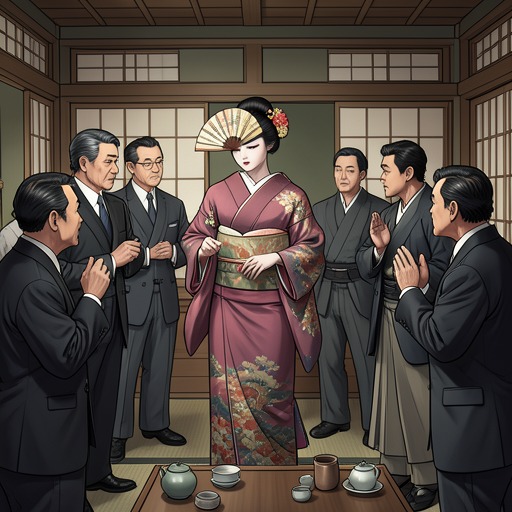
By the middle of 1943, the geisha community had begun to fear that the war’s demands would overwhelm them. Daily life had become increasingly difficult, and rumors that the military government planned to close Japan’s geisha districts no longer seemed remote. When the announcement finally came, a man told the gathered geisha that the districts were closing and that they must report to the registry office the next morning.
For Sayuri and the others, the order made the future suddenly concrete: they faced the possibility of being sent to factory work and wondered whether any of the men they knew could help them. Sayuri set out to find General Tottori, who had been her danna until the previous year and was rumored to be staying at the Suruya Inn. The closing of the districts was therefore not only a government measure; it threatened the livelihood and social world on which the women’s lives had been built.
Defeat and the Occupation
Sayuri dates the end of the war for her community to August 1945. She remembers the moment as profoundly bleak: Japan had been defeated and devastated, and the arrival of an occupying army made the future feel precarious. In the period that followed, she recalls hearing no laughter for a year or more, apart from a young child whose grandfather quickly hushed him. Her account connects public defeat to its lasting effect on childhood and everyday emotional life.
By spring 1946, the immediate fear had begun to recede. Stories that American soldiers would rape and kill Japanese people proved false; Sayuri and her neighbors gradually found the soldiers remarkably kind. Watching them pass, she recognized how completely her former sense of separation from other women had changed. In torn work clothes, with unwashed hair and little fuel for bathing, she saw herself as no different from the women around her. The surrender thus marks not only the end of a political and military order but a rupture in the identity she had formed as a geisha.
Memory, Loss, and What Remains
The aftermath is presented through the older Sayuri’s recollections, in which objects carry private histories across the break of war. Years earlier, Mr. Tanaka had sent her a wooden box containing the mortuary tablets from her childhood home, including two bearing unfamiliar Buddhist names. Their arrival gave her a material remnant of the family life from which she had been separated; they remain part of the story’s chain of remembered losses.
Later, when Sayuri fears that her connection with the Chairman may have ended, she holds his handkerchief and recalls those tablets. She decides that the tablets preserve her childhood and that the handkerchief will preserve the rest of her life. In old age, the Chairman says that memories can seem more real than what is seen in the present. Together, these objects and reflections place the end of the war within a larger pattern of personal and historical memory: public upheaval changes the world, while small, surviving things help the narrator give shape to what has been lost and what endures.